Hey there, if you’re here because you’re shopping around for off line lamination machines for sandwich SAP sheets (you know, those absorbent pads that make disposable diapers, incontinence products, and even some medical wound dressings), I get it—you’ve got a million specs to check. Durability, speed, sheet precision, and yeah, noise level. A lot of folks sleep on that last one until their operators are complaining about ringing ears by the end of a 12-hour shift, or OSHA comes knocking, or their whole shop floor sounds like a construction zone when someone stops by for a visit. Today, let’s break down exactly how loud these off line sandwich SAP lamination machines actually get, what factors make it quieter (or way louder), and what you should actually be asking for when you’re vetting suppliers like me. Sandwich SAP Sheet Lamination Machine Off Line
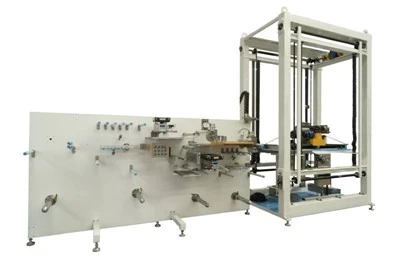
First off, let’s get one thing straight: off line lamination machines aren’t all the same. They don’t look identical, they don’t run the same parts, and they definitely don’t have the same noise output. I see this all the time—buyers will grab a spec sheet from a random competitor that says “85 dB” and assume every machine on the market hits that, but that’s like saying every car gets 30 mpg. It depends on so many variables. Let’s start with the basics of how an off line sandwich SAP lamination machine works, because that’s where the noise comes from. Off line means this machine isn’t hooked directly into your existing diaper or pad production line—you’re feeding pre-made rolls of nonwoven, SAP (superabsorbent polymer) granules, and maybe a backsheet or a top sheet, into this standalone unit to laminate them all together into a finished core. The main moving parts that generate noise here are: the unwind/rewind stations pulling those tight rolls, the granulator (wait, no—wait, we’re laminating, not cutting), wait, the dosing system that drops the SAP evenly, the laminating rollers pressing all the layers together, the cutting unit that trims the finished sheets to size, and the motor/gearbox assembly that powers everything. Got it? Those are the loud bits.
Now, let’s get to the actual numbers, because that’s what you’re here for. When we test our machines, we follow ISO 11201 standards—don’t freak out, that’s just the international way to measure industrial noise, we test at a standard distance of 1 meter from the machine, half a meter above the floor, so it’s comparable across brands. For our standard line of off line sandwich SAP lamination machines, the average running noise is between 78 dB and 82 dB when they’re operating at full production speed (which is usually around 120 to 150 linear meters per minute, depending on model). Wait, let’s put that in perspective for anyone who’s not a noise tech. A normal conversation is about 60 dB. A vacuum cleaner is about 70 dB. A lawnmower is around 90 dB. So our machines are quieter than a lawnmower, louder than a normal chat. But here’s the catch: that’s when everything’s working right, on a good day, with properly maintained parts. If you run a machine with worn rollers, a misaligned dosing system, or cheap, unbalanced motors, you can easily jump 5 to 10 dB, which is a huge difference. That’s why a lot of cheaper off line lamination machines you’ll see online will slap “85 dB” on their spec sheets—because they’re running with beat-up parts, or they measure noise right next to the motor where it’s way louder than where an operator would be standing.
Wait, let’s break down the variables that make a big difference here, because this is where choosing the right supplier pays off. First, the machine’s design. Off line sandwich SAP lamination machines have two main types of laminating systems: hot melt lamination and pressure-sensitive lamination. Hot melt systems use heated adhesive to bond the layers, and their noise output is usually a bit lower because the rollers are smoother, less grinding involved. Pressure-sensitive uses adhesive that’s already on the layers, so the rollers have to press harder, which can add a few dB. But more importantly, the build quality of the frame matters. A lot of cheap machines have thin steel frames that vibrate like crazy when they run— that vibration turns into noise, and it’s not just annoying, it wears parts out faster. Our machines use thick, reinforced cast steel frames with vibration-dampening pads on all the moving joints, so that vibration is cut way before it turns into loud noise. I’ve seen competitors’ machines that vibrate so much at full speed you can feel the whole frame shake across the shop floor—adds 10 dB easy, and over time, that vibration will crack frames, misalign rollers, and make your laminate sheets come out uneven.
Next, operating conditions. If you’re running your machine 24/7 at max speed with no maintenance, that noise will go up. Same with if you’re using cheap, low-quality SAP that’s too course, so the dosing system rattles as it drops granules— that’s a common one. Fine, consistent SAP is quieter, because it flows smoothly through the dosing hopper, no clogs or rattle. Also, the surrounding environment matters. If your shop is empty, with hard concrete floors and no sound absorption, you’re going to perceive the machine as louder than if you have soft walls, other machines that muffle the sound, or sound panels hung from the ceiling. Our 80 dB machine will feel louder in an empty garage than a 85 dB machine in a well-insulated production hall.
Now, what’s the OSHA limit, just so you know? In the US, OSHA says the maximum allowable noise exposure over an 8-hour shift is 90 dB, with a 5 dB decrease for every doubling of time. So if our machines are at 80 dB, that’s way under the limit—operators can be around them all day without ear protection, if you want, though most shops still give them ear muffs just as a precaution, and a lot of our customers do that too. Cheaper machines that hit 88 or 90 dB? Operators have to wear hearing protection, which slows them down, can cause fatigue, and over time leads to hearing damage. I had a customer a few months back who switched from a competitor’s machine to ours, and he said his operators stopped complaining about ringing ears by the end of the first week. That’s a win right there.
Wait, let’s address a question I get all the time: can you make an off line sandwich SAP lamination machine quieter? Yeah, definitely, but you pay for it. You can add sound enclosures, but those add cost, and they make it harder to access the machine for maintenance, which is a hassle. The better way is to build quiet into the machine from the start. That’s what we do. We balance all the rotating parts (rollers, motor shafts, rewind spools) so they don’t vibrate. We use variable speed motors instead of old, fixed-speed ones—they run smoother, quieter, and you can adjust speed for different jobs. We use low-noise cutting blades, not cheap ones that make a high-pitched squeal when they trim the sheets. All those small things add up to a machine that’s not just quieter, but more reliable too. A lot of suppliers will tell you “noise doesn’t matter” and sell you a $10k machine that’s loud, but in the long run, that’s costing you more in hearing protection, operator turnover, and maintenance.
I know a lot of you reading this are production managers or owners who are focused on throughput and quality, and noise might feel like a afterthought. But let’s be real: if your team is miserable working in a loud shop, they’re going to make more mistakes, take more sick days, and quit more often. Operator turnover in lamination production is already high—you don’t need loud machines making that worse. I’ve had customers tell me that when they upgraded to our quieter machines, their error rates on the laminate sheets dropped by 15%, because their operators could focus instead of covering their ears all day. That’s a tangible, hard dollar savings, right there, way more than whatever you might save on a cheaper, louder machine.
Let’s bust a myth here, too: people think off line machines are louder than in line ones, because in line ones are integrated into a whole production line that has sound dampening from all the other parts. No, that’s not true. Our off line machines are actually quieter than most in line systems, because in line lines have multiple machines running together, adding up to more noise. I had a customer who was running an in line line that was at 92 dB, and he swapped out a part of it for our off line unit and his whole shop noise level dropped by 7 dB. That’s a huge difference.
So when you’re shopping around for off line sandwich SAP lamination machines, here’s what to look for, not just the pretty pictures or low price. First, ask for the noise measurement at 1 meter, running at full production speed, not next to the motor. Ask what testing standard they used—ISO 11201 is the right one for industrial machines, not whatever they pulled out of thin air. Ask if they use vibration-dampening parts, balanced rotating components, and low-noise motors. And don’t sleep on the long-term costs: a $20k machine that’s quiet, reliable, and has low operator turnover is way better than a $15k machine that’s loud, breaks down every other week, and makes your team quit.
If you’re looking to chat more about what noise level makes sense for your shop, what model would fit your production needs, or want to get a real test run (we can even send someone to your facility to demo a machine, if you’re local), just reach out. I know buying new equipment is a big deal, and you want to make sure you’re getting something that works for your team and your bottom line. Don’t just go with the first supplier that hits you up with the lowest price—ask the right questions, about noise, about reliability, about support. That’s how you make a call that doesn’t come back to bite you 6 months down the line.
Sandwich SAP Sheet Lamination Machine References
Occupational Safety and Health Administration. (2024). Noise Exposure Limits. Retrieved from OSHA Technical Manual.
International Organization for Standardization. (2017). Acoustics – Noise emitted by machinery and equipment – Rules for the preparation of noise test codes (ISO 11201).
Textile and Nonwoven Industry Machinery Association. (2023). Guidelines for Lamination Machine Performance and Noise Standards.
Quanzhou Thinkcha Precision Machine Co., Ltd.
As one of the most experienced sandwich SAP sheet lamination machine off line manufacturers and suppliers in China, we also support ODM service. Please feel free to buy the best sandwich SAP sheet lamination machine off line at competitive price from our factory. Contact us for more details.
Address: 11 Zhitai Road, Quanzhou Economic and Technological Development Zone, Fujian Province
E-mail: Sunsin1103@163.com
WebSite: https://www.thinkchamachine.com/
