Hey everyone, if you’re deep in the manufacturing game—whether you’re making automotive sensors, small electronics housings, or medical connectors—you’ve probably wondered: what’s the real cost of a metal insert vertical injection molding machine? As a guy who’s been supplying these bad boys for over a decade, I get it. You don’t just look at the sticker price. There’s way more hidden stuff that can make or break your budget. Let me break this down like I would for a buddy in the shop, no jargon, no confusing charts. Metal Insert Vertical Injection Molding Machine
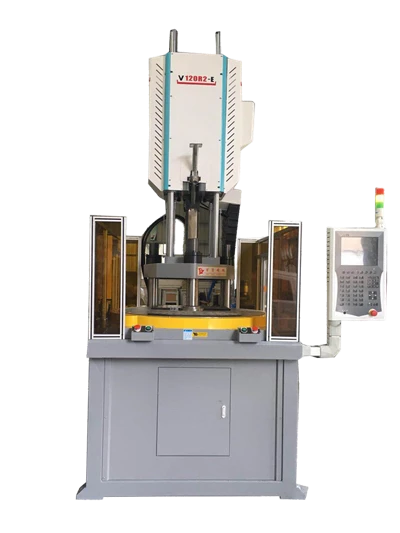
First off, let’s get one thing straight: these aren’t your horizontal injection molding machines you see cranking out plastic toys all day. Vertical insert machines are built differently. They’re designed to drop a metal insert (like a brass pin, steel nut, or aluminum bracket) into the mold, clamp it in place, shoot plastic around it, and pull out a finished part—all in one cycle. No transferring parts between machines, which cuts down on errors. But that specialized build means the cost range is way wider than standard horizontal machines.
Now, let’s talk base prices, because that’s what everyone asks first. I see entry-level models for small, low-volume jobs starting around $15,000 to $25,000. These are perfect if you’re a small business prototyping parts or running 5,000 to 20,000 units a month. They’re basic: manual insert loading, smaller platens (the plates that hold the mold), and less advanced controls. But if you’re cranking out 100,000+ units, or need automation to keep up, mid-range models hit $35,000 to $70,000. These have automated insert feeders, better precision controls, and faster cycle times. Then there are the heavy-duty, industrial-grade machines for high-volume, tight-tolerance parts—think medical implants or automotive engine components—and those can run you $80,000 up to $200,000. Yeah, that’s a huge gap, but it all ties back to what you actually need.
Wait, but hold on—base price isn’t the end. There’s a bunch of add-ons that can jack up the cost (or save you money in the long run). Let’s start with automation. If you’re still loading inserts by hand, you’re wasting labor and making parts with more errors. An automatic insert feeder—something that picks up metal parts, aligns them, and drops them into the mold—adds $5,000 to $15,000. For high-volume jobs, that’s non-negotiable. No more paying a guy $15 an hour to load inserts all day, plus fewer defective parts because human error is gone. Then there’s mold compatibility. If you already have a mold for vertical use, great—most entry machines work with standard molds, but if you need a custom mold (which almost everyone does for insert molding), that’s another $2,000 to $10,000 on top. Don’t forget the control system either. Basic PLC controls are fine for simple parts, but if you need to track cycle data, adjust pressure in real time, or integrate with your factory’s ERP system, a upgraded touchscreen control with data logging will set you back another $3,000 to $8,000.
Now, let’s talk about hidden costs that no one tells you about. First, installation and training. A lot of entry-level machines are semi-portable, but mid-to-heavy duty ones need professional installation—electrical wiring, floor prep, leveling. That can run you $1,000 to $5,000. And if your team has never run an insert machine before? Training is non-negotiable. We include basic training with every machine, but advanced training for troubleshooting and optimizing cycles is $2,000 to $4,000 more. Then there’s maintenance and parts. These machines have moving parts—clamps, injection units, insert feeders. Filter changes, lubrication, and replacement parts (like nozzles or feeder belts) add up. Budget about 2% to 3% of the machine’s total cost every year for maintenance. That’s $300 to $6,000 a year, depending on the model. Also, electricity—industrial machines use way more power than standard equipment. A mid-range model uses about 10-15 kW of power, so your electric bill will go up $50 to $100 a month, depending on local rates.
Wait, but what about resale value? I’ve seen a lot of guys skip new machines and go used, and that’s a valid move if you know what you’re getting. Used vertical insert machines can be 30% to 60% cheaper than new, but you have to check for wear—like worn platens or faulty insert feeders that will break down on you in a year. A used entry model might be $8,000 to $15,000, but if it’s 10+ years old, you’re probably looking at more maintenance costs down the line. New is better if you want a warranty and no surprises—we offer a 2-year warranty on all our machines, plus 24/7 tech support, which is worth its weight in gold when your line goes down at 2 a.m.
Let’s also tie this to real-world examples, because numbers mean nothing without context. A friend of mine runs a small electronics shop that makes custom smartphone cases with brass inserts for charging ports. They started with an entry-level manual insert machine for $18,000. At first, they loaded inserts by hand, but after 6 months, they were doing 50,000 units a month and had to add an automatic feeder for $8,000. Total cost so far: $26,000. They saved about $3,000 a month in labor from switching to automatic, so they made that money back in less than 3 months. Now, another buddy works for a automotive parts manufacturer making engine sensors with steel inserts. They went with a mid-range automated machine for $55,000, plus a custom mold for $7,000, plus factory installation for $3,000. Total: $65,000. They do 200,000 units a month, and the precision of the machine cuts defect rates from 8% to under 1%, which saves them $12,000 a month in scrap. That payoff was like 5 months.
So, how do you figure out what’s right for you? First, calculate your monthly volume. If you’re under 20,000 units a month, entry-level is probably enough. Between 20,000 and 100,000, mid-range with automation is a no-brainer. Over 100,000, you need heavy-duty industrial model. Then, look at your part tolerance—if you need parts that fit medical standards (like ISO 13485), you need a machine with tighter precision controls, which will cost more, but it’s non-negotiable for compliance. Also, factor in labor costs. If you’re paying people to load inserts 8 hours a day, an automatic feeder will pay for itself fast.
Here’s the thing I tell every customer: don’t just chase the lowest sticker price. I’ve had guys buy a $12,000 entry machine, then a month later call me because the insert feeder breaks and they can’t scale. They end up spending another $10,000 to upgrade to a mid-range model, which was more expensive upfront but would’ve saved them time and money. The total cost of ownership is what matters, not just the initial price.

If you’re still not sure, or you want to talk through your specific part needs—whether it’s metal inserts, plastic material, monthly volume—hit me up. I don’t do pushy sales pitches. I just give you the straight scoop, help you figure out what machine fits your budget and production goals, no hidden fees, no confusing fine print. Whether you’re a small shop just starting out or a big manufacturer looking to upgrade your line, I’ve got you covered. Reach out anytime to chat about pricing, specs, or even just ask more questions about these machines.
Specific Vertical Injection Moulding Machine References
- Plastic Technology, "Vertical vs. Horizontal Injection Molding: Key Differences for Production", 2022.
- Society of Plastics Engineers (SPE), "Insert Molding Best Practices and Cost Analysis", 2021.
- Modern Machine Shop, "Total Cost of Ownership for Injection Molding Equipment", 2023.
- Automotive Manufacturing Solutions, "Precision Molding for Automotive Components: Machine Requirements", 2022.
Guangdong Baizan Intelligent Equipment Co., Ltd.
We are one of the most professional metal insert vertical injection molding machine manufacturers and suppliers in China. We warmly welcome you to buy customized metal insert vertical injection molding machine at competitive price from our factory. If you have any enquiry about pricelist and quotation, please feel free to email us.
Address: No.8, Jianye Road, Dahuai Town, Enping City, Jiangmen City, Guangdong
E-mail: wjx@baizanjx.com
WebSite: https://www.baizanplast.com/
